|
I am an undergraduate student at Seoul National University majoring in Electrical and Computer Engineering (ECE), and I am currently conducting a research internship at RLWRLD. My research interests lie at the intersection of Robot Learning and Physical AI, specifically focusing on how agents can learn complex manipulation tasks in unstructured environments. Email / CV / Google Scholar / Github / LinkedIn |
|
News
| 2026.04 | Joined RLWRLD as an AI Research Intern, working on memory-augmented VLA models. |
| 2026.02 | Our paper Adaptive Capacity Allocation for VLA Fine-tuning was accepted to ICRA 2026. |
Research FocusI view the generalization failure of current robot foundation models as a context uncertainty problem: when the current observation is insufficient for action selection, a robot must maintain, retrieve, and translate task-relevant context into guidance that a low-level policy can execute. Vision-language-action (VLA) models inherit broad visual and semantic knowledge from pretrained VLMs, but this knowledge is not always grounded in a form that supports reliable action generation after robot-data fine-tuning. To address this, I study hierarchical VLM–VLA systems, in which a VLM-based high-level policy keeps track of task progress, episodic memory, and embodiment-specific context, reasons about the uncertainty of the current situation, and provides structured guidance to a low-level VLA policy. My work has progressed from real-world VLA deployment, through capacity allocation for VLA fine-tuning and action-level subtask discovery, to explicit language memory for non-Markovian manipulation. Going forward, I am interested in agentic VLMs that decide what to remember, what to retrieve, and how to guide the VLA, choosing among text memory, keyframe retrieval, visual traces, keypoints, or latent guidance as the situation demands. |
Publications

|
HeLM: Hierarchical Explicit Language Memory for Non-Markovian Manipulation
Gyeonghun Kim†, Donghoon Kim, Minsoo Choi, Suyun Lee †Corresponding author. ICRA 2027, Under Review Project Page / Code / arXiv To tackle non-Markovian manipulation, where the current observation alone is insufficient for action selection, HeLM uses a VLM-based high-level policy that maintains an explicit language memory of task progress and guides a low-level VLA policy. It improves success rate by 13% on real-world non-Markovian tasks. |
|
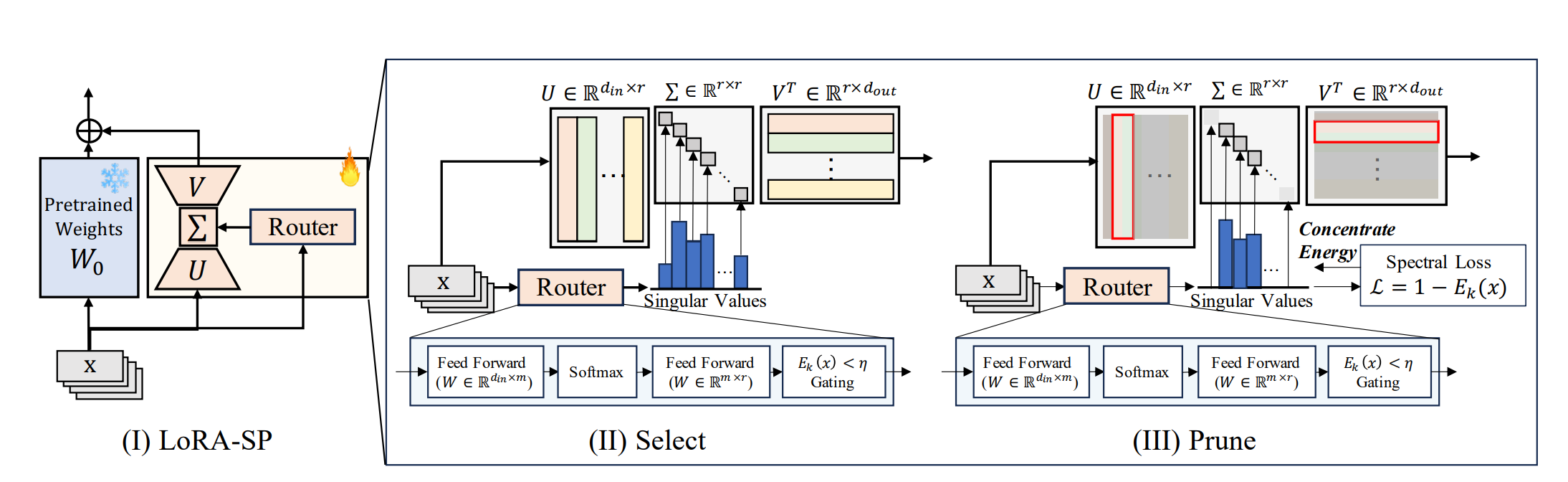
Adaptive Capacity Allocation for Vision Language Action Fine-tuning
Donghoon Kim, Minji Bae*, Unghui Nam*, Gyeonghun Kim*, Suyun Lee*, Kyuhong Shim†, Byonghyo Shim† *Equal contribution as co-second authors. ICRA 2026, Accepted Project Page / Code / arXiv To address the adaptation bottleneck of fine-tuning VLA models for unseen embodiments and multi-task learning, we propose a rank-adaptive LoRA that allocates capacity according to task and embodiment demands. It achieves a 23.3% improvement over the baseline on π₀. |
Projects
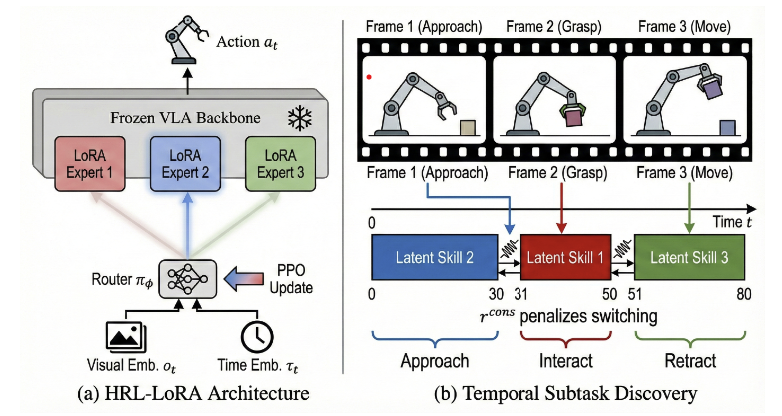 |
HRL-LoRA: Hierarchical RL for Consistent Subtask Discovery in VLAs
Gyeonghun Kim Course Project, Stochastic Reinforcement Learning, SNU, 2025 Proposed a hierarchical framework that discovers robotic subtasks without manual supervision by attaching independent LoRA experts to a frozen VLA backbone (π₀) and training a PPO router to select experts. To make the discovered subtasks meaningful, I further introduced a consistency-aware reward that induces temporally coherent, interpretable subtask segmentation, and showed that entropy regularization is critical to avoid degenerate routing collapse. |